Best Jackknife RV Sofa Beds: A Buying Guide for Small Spaces
Share
Shopping for an RV sofa bed usually means picking a mechanism first and a fabric second. Jackknife sofa beds are one of four common designs used in RVs and campers, and they're the pick most owners reach for when floor space is tight. This guide breaks down how jackknife beds work, how they compare to hide-a-bed, trifold, and clickback designs, and what to check before you buy — including a look at Koala's own space-saving sofa bed collection for anyone furnishing a fixed space instead of a rig.
What Is a Jackknife RV Sofa Bed? (How the Mechanism Works)
A jackknife sofa bed is a sleeper sofa that opens by pushing the seat cushion forward and lowering the backrest until the two panels lie flat, similar to how a pocketknife blade folds out. The name comes from that folding motion — the seat and back "hinge" open instead of pulling out or lifting.
Most jackknife models use a metal hinge bar running the width of the sofa. To open the bed, you release a latch, guide the seat forward on its frame, and let the backrest drop down to meet it. The result is a flat sleeping surface roughly level with the seat height, usually 19–20 inches off the floor. Closing the bed just reverses the steps, which takes most people under a minute once they know the sofa.
Why Jackknife RV Sofa Beds Suit Small Spaces
Jackknife RV sofa beds suit small spaces because they open forward and down instead of sliding backward, so they don't need wall clearance behind the sofa. That's a real advantage in a rig where the sofa backs onto a slide-out wall, a cabinet, or another piece of furniture.
A few other reasons this mechanism shows up so often in campers and travel trailers:
-
Lighter frames. Jackknife hardware is simpler than a pull-out hide-a-bed frame, which keeps the sofa's overall weight down — a real factor when every pound affects towing capacity.
-
Smaller footprint when closed. Because the mechanism folds rather than telescopes, jackknife sofas tend to have a shallower seated depth than sleeper sofas built for houses.
-
Dual-purpose during the day. The sofa works as normal daytime seating without needing to store a mattress elsewhere, which matters when there's no spare closet for bedding.
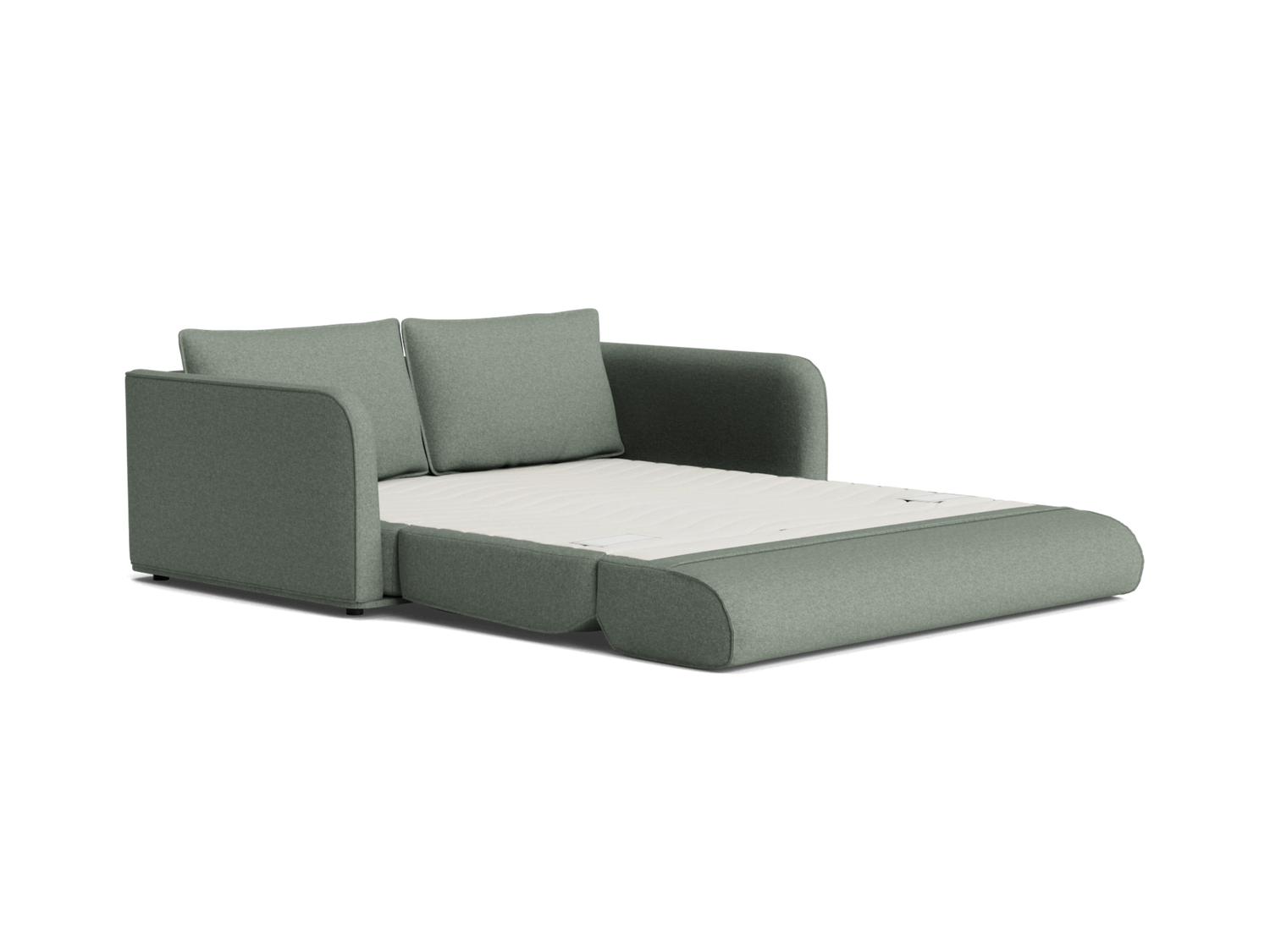
That fold-flat logic isn't limited to actual RVs, either. Koala's sofa beds apply a similar principle in the Koala Sofa Bed [4th Gen] and Byron Sofa Bed [3rd Gen], both built on Koala's FlipBed™ design — a sit-to-sleep conversion with no mechanical hinge at all — for apartments, tiny homes, and park models with room for a full-size doorway.
Jackknife vs. Hide-a-Bed vs. Trifold vs. Clickback: Which Mechanism Fits Your Rig?
The four mechanisms differ mainly in how far they extend and how much clearance they need. Here's how they stack up:
|
Mechanism |
How It Opens |
Clearance Needed |
Typical Width Range |
Best For |
|
Jackknife |
Seat folds forward, back drops flat |
Little to none behind the sofa |
60"–76" |
Rigs with a wall or slide-out close behind the seating area |
|
Hide-a-bed |
Frame pulls out and extends beyond the sofa's footprint |
Several feet of open floor in front |
62"–65" |
Rigs with an open living area and no obstruction in front |
|
Trifold |
Cushions unfold in three flat sections |
Minimal — mostly floor space, not wall clearance |
62"–72" |
Owners who want a simple, tool-free setup each night |
|
Clickback |
Backrest reclines through several locked positions before lying flat |
Little to none, similar to jackknife |
60"–66" |
Owners who want adjustable lounging positions, not just a flat bed |
|
FlipBed™ (Koala) |
Sit-to-sleep cushion flip — no hinge or mechanical parts |
None — flips flat in place |
46"–92" (varies by model) |
Anyone who wants jackknife-style compactness without a mechanism to maintain |
Exact clearance and weight figures for the first four mechanisms vary by manufacturer and model, so treat those ranges as a starting point rather than a spec sheet.
What to Check Before You Buy: Doorway Width, Weight & Clearance
Check three numbers before you order any RV sofa bed: the doorway width it needs to pass through, the sofa's shipping weight, and the clearance it needs to fully open. Getting any of these wrong usually means a return.
-
Doorway width. RV entry doors are narrower than standard home doorways — most run 26"–30" wide, with some Class A motorhomes as narrow as 24" — and manufacturers typically list a "fits through" measurement for exactly this reason.
-
Weight. Sofa weight affects both installation (can you and one other person carry it in?) and towing capacity, especially in lighter trailers. Compare the listed weight against what your rig's floor plan and hitch weight can handle.
-
Open clearance. Even a jackknife bed needs a little room to fold — measure from the front of the sofa to the nearest obstruction, and compare it to the manufacturer's "reclined depth" or "bed position depth" spec.
-
Anchoring. Most RV sofas bolt to the floor through pre-drilled holes in the frame. If you're installing furniture that wasn't built for an RV, plan on adding floor anchors rated for its weight.
Flat-pack delivery can also solve a tight-doorway problem before it starts. Koala's own sofa beds ship in multiple boxes rather than fully assembled — five boxes for the Koala Sofa Bed [4th Gen] and Byron Sofa Bed [3rd Gen], four for Wanda — so no single piece is as large as an assembled sofa when it comes through the door.
If you're specifically outfitting a camper rather than a full-size RV, our guide to the best sofa beds for campers covers more compact options worth comparing.
Top Jackknife (and Space-Saving) RV Sofa Bed Picks
Koala doesn't build RV-specific furniture, but its sofa bed range is engineered around the same problem: a small footprint, an easy conversion, and a bed that doesn't feel like an afterthought. If your build can accept residential dimensions — a converted van, a tiny home, or a park model with a full-size doorway — here's how the three models compare.
Koala Sofa Bed [4th Gen] is the most compact of the three, sized 46" Twin XL (from $1,450), 64" Full ($1,850), or 70" Queen ($1,990) at the time of writing. It uses Koala's FlipBed™ design — a sit-to-sleep flip with no mechanical hinge — with an integrated Kloudcell™ topper and Lifeproof fabrics that are machine-washable and water-resistant.
Byron Sofa Bed [3rd Gen] is the deeper-seated option, sized 92" Queen only, $2,395 at the time of writing. It also uses FlipBed™, plus a 6-inch integrated Kloudcell™ sleep surface and Zero Disturbance™ motion isolation — the only sofa bed in Koala's range with that feature, useful if two people don't want to feel each other move at night. Covers are machine-washable, and it has more hidden storage than the 4th Gen.
Wanda Sofa Bed is the largest and most flexible, at 99" Queen only, $3,295 at the time of writing. Wanda isn't a FlipBed™ model — it converts via a slide-out queen-size sleep platform with a Kloudcell™ topper, and switches between sofa, reversible chaise, daybed, and bed. One tradeoff: Wanda's covers are spot-clean only, not machine-washable, so it's worth ruling in or out early if easy cleaning is a priority.
Both the 4th Gen and Byron have a matching ottoman if you want extra seating or a footrest that doubles as storage. The Koala Sofa Bed Ottoman [4th Gen] ($450) has a flippable top that works as a side table over hidden storage, in the same Koala-exclusive fabrics as the sofa. The Byron Sofa Bed Ottoman [3rd Gen] ($395) has removable, washable covers and carries its own 5-year warranty. There's no matching ottoman for Wanda.
The 4th Gen and Byron both publish an exact bed-mode footprint on their dimension diagrams: the 4th Gen opens to 88" deep, with a width that varies by size — 37" for Twin XL, 55" for Full, and 61" for Queen — while Byron opens to a fixed 80" wide by 70" deep. Wanda's slide-out queen platform doesn't have an equivalent labeled figure on its page — Koala just calls it "queen-sized" — so treat that one as comparable to a queen mattress rather than an exact match. All three carry Koala's standard 5-year warranty and 120-day trial.
Prices above reflect Koala's standard pricing at the time of writing. Koala runs frequent promotions and adjusts pricing often, so it's worth checking the website for current pricing and any ongoing sale before you buy.
Mattress Comfort, Fabric & Warranty Considerations
Mattress thickness, fabric type, and warranty length vary more between RV sofa beds than the mechanism does, and they matter just as much for comfort. A thin foam pad and a well-cushioned foam mattress can sit inside the same mechanism with very different sleep quality.
Look for a mattress that's at least a few inches thick with some density to it — a mattress that's too thin will telegraph the frame underneath. Vinyl and faux-leather fabrics wipe clean easily and hold up to sun exposure, which matters if your sofa sits near a window, while woven fabrics tend to feel softer but show stains more easily. Warranty terms typically run 3 to 7 years depending on the fabric and component, and coverage is worth checking closely — frame, mechanism, and fabric aren't always bundled into the same warranty period.
On Koala's own range, all three sofa beds carry a 5-year warranty and a 120-day trial, but fabric care differs by model: the Koala Sofa Bed [4th Gen] and Byron Sofa Bed [3rd Gen] use Lifeproof fabrics that are machine-washable and water-resistant, while the Wanda Sofa Bed's covers are spot-clean only. If easy cleaning matters more than Wanda's extra size and 4-in-1 versatility, that's usually the deciding factor. Koala also sells matching replacement cover packs for the 4th Gen and Byron, so a stain or a style refresh doesn't mean replacing the whole sofa.
If budget is the main constraint rather than warranty length, our roundup of the best sofa beds under $1,500 breaks down where the price differences actually show up.
Try it in your space: Ready to swap the fold-out for something that actually feels like furniture? Koala's sofa beds use a one-motion, no-tools conversion and ship flat-packed to clear tight doorways — browse the collection or compare the Koala, Byron, and Wanda sofa beds — plus their matching ottomans — to find your fit.
Frequently Asked Questions
Can I replace the couch in my RV?
Yes — most owners can swap in a different couch, but check dimensions, weight, and whether it clears the entry door (typically 26"–30", sometimes as narrow as 24" on Class A motorhomes) first. RV-specific furniture is lighter and built to bolt down, so a standard residential couch may need modification to install safely.
How are RV couches measured?
They're measured at their outermost points for width, depth, and height while upright, plus a separate "bed" or reclined depth if the sofa folds out. If a slide-out sits near the sofa, measure floor space with the slide both in and out.
How do you secure a couch in an RV?
Most RV sofas bolt to the floor or a mounting bracket through pre-drilled holes in the frame to keep them from shifting in transit. Furniture not built for an RV should get added floor anchors or L-brackets rated for its weight.
Can you put any couch in a camper?
Not reliably — residential couches run heavier and bulkier than RV-rated furniture. Confirm doorway clearance (disassembly is often required), your rig's weight limit, and secure anchoring before installing one.
What doorway width do I need for a sofa bed?
Most RV entry doors are 26"–30" wide, with some Class A motorhomes as narrow as 24", and jackknife or sleeper sofas are generally designed to fit that range, sometimes via a detachable backrest or legs. Always confirm the manufacturer's stated "fits through" measurement before ordering.