What Is a Sofa Bed? How to Choose One in 6 Steps
Share
A sofa bed is one of the smartest pieces of furniture you can own when space is tight. It gives you somewhere comfortable to sit every day and a real bed for guests at night — all in the footprint of a single couch. If you've been asking what is a sofa bed and how to pick the right one, this guide walks you through it in six clear steps.
What Is a Sofa Bed?
A sofa bed is a couch that transforms into a bed, giving you seating by day and a sleeping surface by night. It's built around a hidden or integrated mechanism that lets you switch between the two in seconds or minutes, depending on the design.
In the US furniture market, a handful of names all point to the same thing. Sofa bed, sleeper sofa, pull-out couch, convertible sofa, and couch bed are used more or less interchangeably. There's one small distinction worth knowing: "sleeper sofa" usually refers to the pull-out style with a mattress hidden inside the frame, while "sofa bed" is the broader umbrella that also covers futons, flip designs, and slide-out platforms.
Sofa beds shine in apartments, studios, home offices, and living rooms that occasionally double as guest rooms. When you're ready to see the options side by side, browse a full sofa bed collection so you can compare sizes, layouts, and conversion styles in one place.
How Does a Sofa Bed Work? (Types and Mechanisms)
Every sofa bed does the same job — it turns seating into a flat sleeping surface — but the mechanism is what sets each type apart. The mechanism affects how fast it converts, how much space it needs, and how comfortable it feels once it's open.
Here are the main types you'll come across:
|
Type |
How it converts |
Sleep surface |
Best for |
|
Pull-out (fold-out) |
Remove cushions, pull a metal frame up and out |
Separate mattress inside the frame |
Frequent guests, traditional look |
|
Fold-back / flip (FlipBed™) |
Seat cushions fold back to reveal the bed |
Integrated foam surface |
Fast, tool-free daily use |
|
Slide-out platform |
A platform rolls forward from beneath a chaise |
Foam topper on the platform |
Flexible, chaise-based layouts |
|
Futon |
Backrest folds completely flat |
Seat cushion doubles as the mattress |
Very compact rooms, tight budgets |
|
Sectional sleeper sofa |
Pull-out mattress built into one section |
Separate mattress inside the frame |
Larger rooms, regular hosting |
The classic pull-out sofa bed hides a folded mattress inside the frame. You lift off the seat cushions and pull the frame forward until it unfolds. A good one sleeps close to a real bed, though older versions could have a "bar in the middle" feel and need clear floor space to extend.
Flip-style designs skip the separate mattress. The seat cushions fold back to uncover an integrated foam surface, so there's no heavy frame to wrestle with. The Koala Sofa Bed [4th Gen] and Byron Sofa Bed [3rd Gen] both use this FlipBed™ approach with a Kloudcell™ sleep surface — Koala's open-cell comfort layer built to feel more like a mattress than a couch cushion.
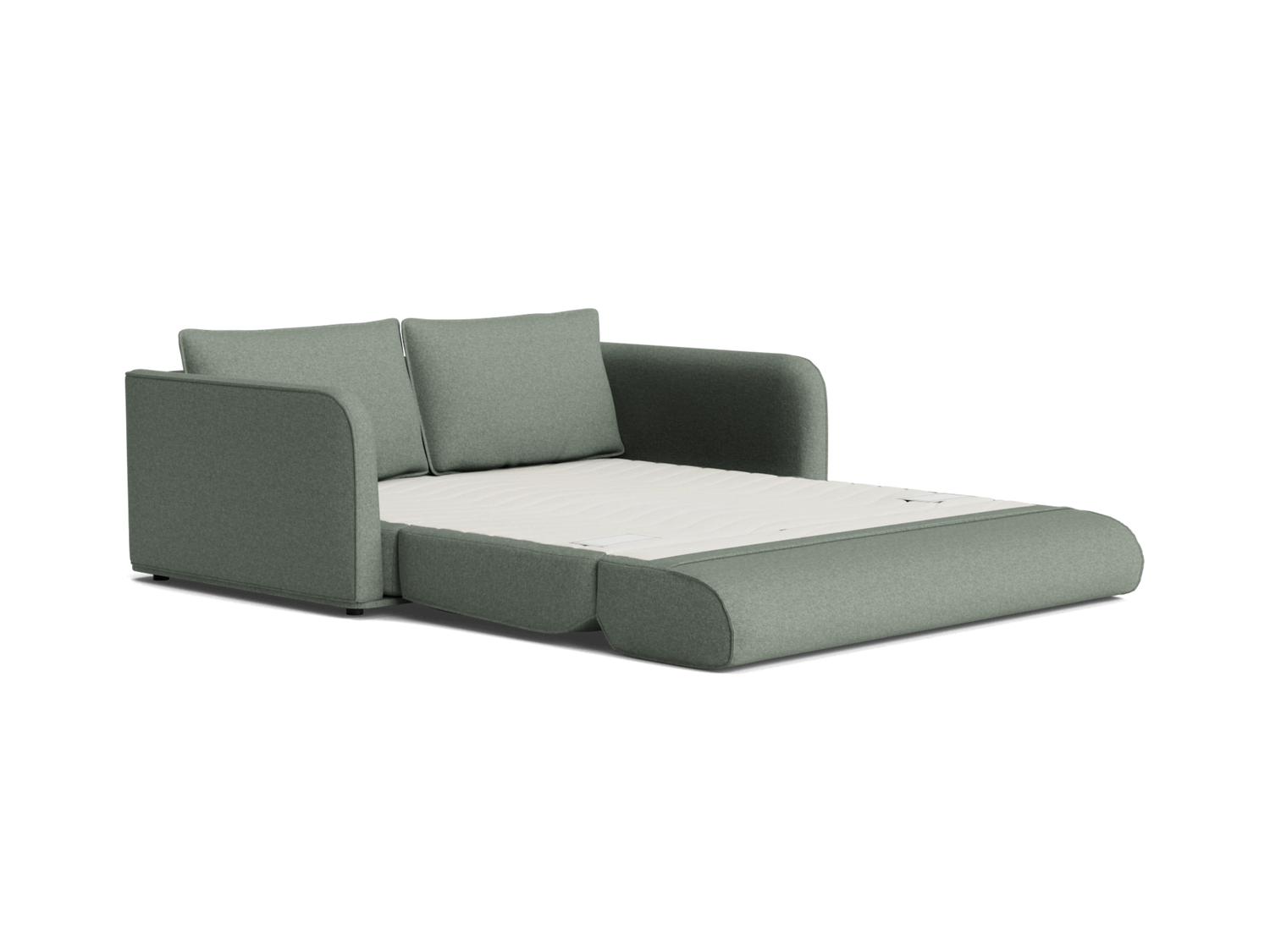
Slide-out platforms roll a sleep surface forward from under a chaise. The Wanda Sofa Bed uses this design, with a reversible chaise so you can flip the layout to suit your room. A futon is the simplest option — the backrest folds flat, and the seat becomes the bed — while a sectional sleeper sofa offers the most seating and sleeping space if you have the floor plan for it.
Sofa Bed Sizes
Sofa beds follow standard US mattress sizes, so knowing the sleeping dimensions upfront makes shopping much easier. The sizes range from Twin for solo sleepers up to King for larger rooms.
|
Size |
Sleeping dimensions |
Best for |
|
Twin |
38" × 75" |
Kids, solo sleepers, tight spaces |
|
Twin XL |
38" × 80" |
Taller solo sleepers |
|
Full |
54" × 75" |
Single adults, compact guest rooms |
|
Queen |
60" × 80" |
Couples and most guest rooms |
|
King |
76" × 80" |
Larger rooms, maximum sleeping space |
Standard US mattress sizes are consistent, so a sofa bed's bed mode is usually described by the size it's comparable to — a "Queen" sofa bed opens to a sleeping surface comparable to a standard queen mattress.
One thing trips up a lot of shoppers: a sofa labeled "Queen" refers to the sleeping surface it's comparable to, not the sofa's overall width. The sofa itself is usually much wider. The Koala Sofa Bed, for example, comes in 46" Twin XL, 64" Full, and 70" Queen sofa widths, while the Byron is 92" wide and available in Queen. Always check both the closed sofa width and the open bed footprint before you buy.
How to Choose a Sofa Bed in 6 Steps
Choosing a sofa bed comes down to six steps: measure the open and closed footprint, decide how often it'll be slept on, pick a mattress type, check the mechanism, verify the warranty, and test the seating comfort at home. Work through them in order, and you'll avoid the most common — and most expensive — buying mistakes.
1. Measure the open and closed footprint
Measure the sofa both closed and fully open, because most people forget the second part. A pull-out or fold-out model extends well forward, and many need roughly 80" to 90" of open depth once extended. The Koala Sofa Bed, for instance, needs about 88" of depth in bed mode. Note your wall width, the open depth, and enough clearance to walk around the bed. When in doubt, tape the open dimensions onto your floor before ordering.
2. Decide how often it'll be slept on
Be honest about the use case, because it shapes every other choice. A sofa bed used a few nights a year for visiting family can meet a very different standard than one slept on most nights. For occasional guests, a simpler mechanism and a mid-thickness surface are fine. For regular or nightly use, prioritize a sturdy frame and a thicker, higher-density sleep surface that won't sag over time.
3. Pick a mattress or sleep surface type
The sleep surface is the single biggest factor in how comfortable a sofa bed feels. As a general buyer's guideline, look for a surface at least 4" to 6" thick — anything much thinner tends to feel exactly as thin as it is. Your main options:
-
Foam or memory foam — cushions the body and eases pressure points; integrated foam avoids the metal-bar feel entirely.
-
Innerspring — a firmer, more traditional bounce; best if you fold it out only occasionally.
-
Integrated foam (like Kloudcell™) — an open-cell foam engineered for consistent support and breathability, with no separate fold-out hardware. The Byron uses a 6" Kloudcell™ surface.
For integrated systems, foam quality matters more than raw thickness.
4. Check the mechanism
A sofa bed that's a chore to open often ends up never being opened, so the mechanism is worth testing. Traditional pull-out couch designs require unfolding a frame and lifting hardware. Flip systems fold the cushions back in seconds. Slide-out platforms simply pull forward. If you'll set up guest space often, faster conversion is worth prioritizing — and if you can, open and close it a few times before you commit, since a stiff mechanism only gets worse with use.
5. Verify the warranty and trial terms
Warranty length is a useful signal of how long a maker expects the frame and mechanism to last. Every Koala sofa bed comes with a 5-year warranty and a 120-day free trial, so you can live with it at home for months and return it free if it isn't right. Check what the warranty covers — frame, mechanism, and foam — and how returns are handled before you buy.
6. Test the seating comfort
A sofa bed still has to work as an everyday couch, so don't judge it on bed mode alone. Check the seat depth, cushion density, and how supported you feel sitting with your feet flat on the floor. Deeper seats suit loungers — the Byron runs a generous 42" seat depth — while more compact seats save floor space. If you're buying online, a genuine at-home trial is the best substitute for a showroom test.
Are Sofa Beds Comfortable? Can You Sleep on One Every Night?
Sofa beds can be very comfortable, but it depends on the type and the quality. A pull-out or flip-style sofa bed with a thick, high-density foam surface can feel great for guests over several nights, while a cheap version with a thin mattress over a metal frame will feel thin by morning. Futons sit firmer still — fine for some people, noticeable at the fold point for others.
For occasional guests, a decent sofa bed is more than comfortable enough. For nightly use as a primary bed, the model matters far more — look for a supportive integrated surface, a solid frame, and no hard pressure points underneath. Modern sofa beds built by sleep-focused brands have closed much of the gap with a standalone bed, though a dedicated mattress will still go further for anyone who needs a specific level of long-term support. If everyday comfort is your top priority, it's worth seeing what makes the most comfortable 3-seater sofa bed before you decide.
Find Your Koala Sofa Bed
The best Koala sofa bed for you depends on your space and how you'll use it. All three convert tool-free, ship free, and come with a 120-day free trial and a 5-year warranty — so you can try before you fully decide.
|
Model |
Sizes |
Price (from)* |
Standout feature |
Best for |
|
Koala Sofa Bed [4th Gen] |
Twin XL, Full, Queen |
From $1,450 |
FlipBed™ + machine-washable covers |
Compact spaces and flexibility |
|
Byron Sofa Bed [3rd Gen] |
Queen |
From $2,195 |
6" Kloudcell™ surface, hidden storage, deep 42" seats |
Everyday comfort and frequent guests |
|
Wanda Sofa Bed |
Queen |
$3,295 |
4-in-1 layout with reversible chaise |
Open-plan rooms and rearranging |
*Starting prices at the time of writing. Premium Fabric options cost more (for example, the Koala Sofa Bed Queen is $1,990, or $2,090 in Premium Fabric), and Koala runs regular sales — check the live product page for current pricing.
Every Koala sofa bed is designed by Koala in Sydney and built with sustainability in mind: the frames use FSC®-certified timber and the foams are CertiPUR-US® certified.
Not sure which to choose? Compare Koala's sleeper sofas side by side to see sizes, fabrics, and layouts together. Every Koala sofa bed converts tool-free and arrives with a 120-day free trial and a 5-year warranty, so you can sleep on it at home before you commit. For a deeper walkthrough, our guide on how to choose a sofa bed breaks down what to look for step by step.
Frequently Asked Questions
What's the difference between a sofa bed, a sleeper sofa, and a couch bed?
In the US, the terms are generally interchangeable — all describe an upholstered sofa that converts into a bed using a hidden mechanism. Technically, "sleeper sofa" often means the pull-out style with a mattress hidden inside the frame, while "sofa bed" is the broader category that also includes futons and flip designs.
Are sofa beds comfortable?
Modern sofa beds can be very comfortable, especially foam-integrated designs that replace thin mattresses and metal bars with a consistent open-cell foam surface. Comfort depends most on the sleep surface, so look for at least 4" to 6" of supportive, high-density foam.
Can you sleep on a sofa bed every night?
Yes, if you choose the right one. A high-quality sofa bed with a supportive integrated sleep surface and a solid frame can handle regular use, while a thin, budget model is better kept for occasional guests.
What size sofa bed fits two people?
A Queen (60" × 80" sleeping surface) is the most comfortable size for two adults and the most common choice for guest use. A Full (54" × 75") works for two who don't mind getting cozy, while Twin and Twin XL suit solo sleepers.
How much room does a sofa bed need when open?
Most sofa beds need roughly 80" to 90" of open depth once fully extended — the Koala Sofa Bed needs about 88". Measure the wall width, the open depth, and walking clearance, then tape the dimensions on your floor before buying to confirm it fits.